
30 June 2026
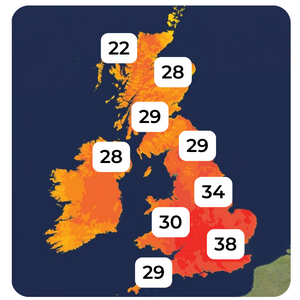
The UK experienced record-breaking temperatures in late May and June, with Red Extreme Heat Warnings in place and forecasts reaching 38°C across central and southern England and Wales.
As a result, these conditions are placing measurable strain on the economy.
How does the hot weather negatively affect the economy?
Hot days cost the UK economy around £1.2 billion per year in lost productivity, with the worst year reaching £5.3 billion (0.2% of GDP)1. These losses come from orders not packed, deliveries delayed, and shifts cut short.
Businesses are shifting working hours, sending staff home, and cutting heavy work during peak heat. Construction sites, logistics operations, and manufacturing lines are especially affected. These sectors are heavy users of Trade Credit Insurance, with 80% of manufacturing companies and 48% of construction businesses adopting the coverage.
1 Source: Office for National Statistics, Impact of Hot Days on Productivity in Great Britain Methodology (ONS Working Paper Series)
Why do these sectors use trade credit insurance so heavily?
Construction faces chronic late payments, supply chain delays, and high insolvency rates. Manufacturing extends large credit lines, relies on continuous cash flow, and is exposed to customer concentration risk.
As mentioned above, these businesses already have strong incentives to buy Trade Credit Insurance due to the potential risky nature of both sectors. Strong heatwave events, like what we’ve all been experiencing recently, will only exacerbate the risk.
How can the heatwave impact trade credit risk?
The recent heatwave has intensified financial pressure on UK businesses, amplifying existing economic uncertainty. A quarter of UK trading firms reported decreased turnover in May 2026, and the extreme temperatures that month further reduced output as productivity dropped and shifts were cut short.
Lower output inevitably means lower revenue, leaving businesses with less cash available to pay their invoices. At the same time, heat related transport and logistics disruptions slowed supply chains, delaying deliveries and, in turn, delaying invoicing or prompting customers to withhold payment.

Operating costs also rose sharply as companies relied on cooling systems, adjusted work schedules, and implemented emergency measures, all of which squeezed liquidity. These pressures are felt most acutely in vulnerable sectors such as construction, agriculture, logistics, retail, and energy intensive manufacturing - industries already prone to elevated insolvency risk during extreme weather.
As heatwaves become more frequent and severe, they may contribute to a broader pattern of climate driven shocks that increase the probability of business failure, particularly for SMEs operating on thin margins.
How Verlingue trade credit team can help
As extreme weather becomes a more consistent feature of the UK’s economic landscape, businesses will need to adapt not only operationally, but financially. Trade credit risk is no longer driven solely by market conditions, but increasingly by climate-related disruption.
Reviewing how your business manages credit exposure - particularly across vulnerable sectors - is becoming an essential part of building resilience in the current environment. If you’d like to discuss how Trade Credit Insurance can help protect your business against rising insolvency and payment risk, speak to our specialists today.

This article is provided for general information only and should not be relied upon as advice. The information reflects market conditions and available data at the time of publication, which may change.