
9 July 2026
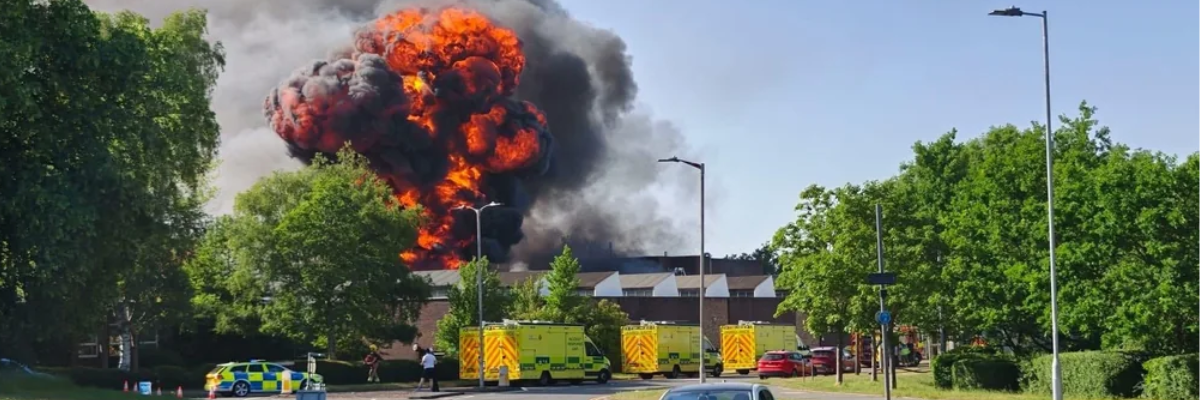
On Bank Holiday Monday, 25 May 2026, a major fire broke out at the Daler-Rowney manufacturing headquarters on Peacock Lane, Bracknell.
Daler-Rowney saw the principal UK facility engulfed in flames, sending smoke visible as far away as Buckinghamshire and forcing the evacuation of around 60 nearby residential properties.
No employees were present due to the bank holiday, and no injuries were reported . However, in the weeks since, a complex and multi-layered picture of risk has emerged: environmental contamination of local waterways, public health concerns, reputational damage, regulatory scrutiny, and significant business disruption.
This article examines the principal risk categories arising from the Daler-Rowney fire and draws out the key lessons for industrial manufacturers across the UK.
Safety risks
Immediate and ongoing
Despite the lack of life threat due to the premises being closed on a bank holiday, the scenario highlights a critical lesson. Fire risk assessments, and emergency response plans must account for out-of-hours incidents where automated fire protection and site monitoring become the only line of defence.
Key safety risks exposed by this incident:
Toxic smoke inhalation risk to nearby residents and emergency responders from burning art materials, solvents, and pigment compounds
Structural collapse risk during firefighting operations in a large manufacturing facility
Secondary chemical reactions from water interaction with stored pigments, lacquers, and industrial solvents
Uncontrolled spread of fire across a mixed-use site containing raw materials, finished goods, and packaging
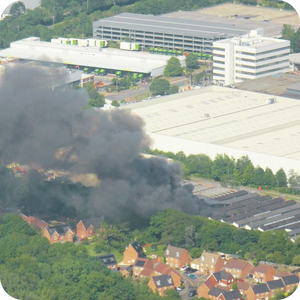
These immediate hazards then have evolved and expanded to further impacts such as requirements for local residents to vacate their homes whilst a thorough and specialist assessment is completed on both private and public locations.
For businesses, this underscores the need to maintain up-to-date material inventories and building composition records; information that becomes critical intelligence for emergency services and public health authorities in the immediate aftermath of an incident.
Environmental risks
Contaminated firewater runoff
One of the most significant and enduring risk consequences of the Daler-Rowney fire has been environmental. Between an estimated 2,000 and 3,000 tonnes of water were used to fight the blaze1. Despite the site being equipped with interceptor chambers monitoring subsequently confirmed that firewater entered the surface water system, with evidence of environmental impact on local waterways. This then compounds to the need to manage this with ongoing monitoring and balancing of already stringent regulation.
Business resilience and continuity risks
Production and supply chain disruption
A major fire at a facility of this strategic importance creates immediate and potentially prolonged production disruption.
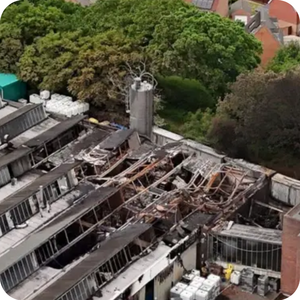
Assessment of the full extent of damage to buildings, plant, raw material stocks, finished goods, and critical infrastructure will take time, and restoration of manufacturing capacity in a specialist facility cannot be achieved quickly.
For customers, supply interruption at a major manufacturer creates gaps that competitors will move to fill. In a sector where product consistency and specialist formulations are important purchase drivers, temporary sourcing alternatives may not provide a satisfactory substitute, but extended unavailability risks longer-term customer attrition.
Communication and stakeholder management risks
The public meeting held on 3rd June revealed significant community frustration with the flow of information in the aftermath of the incident. The MP for Maidenhead publicly characterised the multi-agency response as "disjointed." 2
Conflicting statements emerged between the fire service which stated firewater had been contained and then the Environment Agency and council, which confirmed contamination of the surface water system.
Pre-incident community engagement plans, pre-agreed inter-agency communication protocols, and a dedicated community liaison function can substantially reduce this risk.
Insurance risks
1) Underinsurance and policy adequacy
A major fire at a principal manufacturing facility generates claims simultaneously across multiple insurance lines: property damage, business interruption, public liability, products liability, and environmental liability. The interaction between these policies is frequently more complex than policyholders appreciate until they are in the middle of a loss event.
Underinsurance is one of the most persistent and damaging problems in the UK manufacturing sector. Where declared values are insufficient, the insurer may apply average, reducing the claim payout proportionately at the exact moment when the business needs full financial support.

2) Business interruption cover
Business interruption insurance is designed to replace lost revenue and cover increased costs of working during the period a business cannot trade normally. However, several common gaps in BI policies can severely limit their effectiveness in a major manufacturing loss:
Indemnity periods that are too short - a 12 or 24-month period may be wholly inadequate where the realistic timeline for reinstatement of a specialist manufacturing facility runs to three years or more
Maximum indemnity limits set at turnover rather than gross profit, leading to shortfalls when variable costs reduce
Failure to include supplier and customer extensions, which could respond where the disruption cascades through the supply chain
Pollution or contamination exclusions that may limit or exclude BI claims arising from the environmental consequences of the fire
3) Environmental and pollution liability
Standard commercial insurance policies typically exclude gradual pollution and may impose restrictive conditions on sudden and accidental pollution events. Dedicated environmental liability insurance is an important but frequently absent layer of cover for manufacturing sites handling hazardous substances.
The firewater contamination that entered local waterways following the Daler-Rowney fire illustrates precisely the type of scenario that environmental liability policies are designed to address. Remediation costs, EA oversight costs, third-party property damage claims, and any costs associated with ecological restoration of the nearby watercourse could all fall within scope.
4) Construction cost and timeline risk
Businesses that have not updated their reinstatement cost valuations (whether for insurance purposes or internal financial planning) may find that the gap between anticipated and actual rebuild cost is very substantial. Engaging a specialist reinstatement cost assessor as part of the post-incident response is an important early step.
Key risk management lessons
The Daler-Rowney fire provides an important case study for industrial manufacturers, particularly those handling hazardous or flammable materials. The following risk management priorities emerge from analysis of this incident:
Firewater containment infrastructure must be regularly tested and validated against the realistic volume of water required to suppress a major fire.
Material inventories and building composition records should be maintained in a format immediately accessible to emergency services and public health authorities
Business continuity plans should specifically address the loss of the principal manufacturing facility, including alternative supply arrangements and customer communication protocols with realistic timelines of three to five years, not twelve months with the hope of a miracle bounce back.
Environmental liability insurance should be in place and reviewed in the context of site-specific hydrogeological and drainage risks
Property reinstatement values should be reviewed annually and stress-tested against realistic rebuild timelines for specialist facilities
DSEAR and fire risk assessments must be kept current and reflect actual site conditions, including any changes to stored materials, building modifications, or operational processes
Key customer and supplier communication plans should be activated immediately following a major incident, with honest and regular updates to manage expectations and reduce attrition risk
Crisis communication plans should include pre-agreed inter-agency protocols and a dedicated community liaison role, activated from day one of any significant incident.
Conclusion
The Daler-Rowney fire is a sobering reminder that even long-established, well-regarded manufacturers are not immune to catastrophic loss events. The company's transparent and cooperative response has been widely acknowledged, and the fortunate absence of casualties is genuinely significant. But the weeks of environmental monitoring, specialist clean-up operations, community frustration, insurance and legal complexity, supply chain disruption, and business disruption that have followed the fire illustrate the full breadth of risk consequences from a major industrial incident.
What this incident makes clear is that the consequences of a major fire extend far beyond physical damage on the day. Environmental liability, insurance adequacy, cyber and data recovery, planning complexity, and supply chain resilience are all risk domains that must be addressed proactively not discovered reactively in the middle of a crisis.
For risk managers, safety professionals, and business leaders across the manufacturing sector, this incident warrants a structured review across all ten risk categories examined in this article. The question is not whether your site could experience a similar event but whether, if it did, your risk management framework would genuinely limit the consequences.
Any commentary regarding the Daler-Rowney fire is based on publicly available information at the time of writing. Investigations, regulatory findings, environmental assessments and claims outcomes may continue to develop and could alter the understanding of events described. The information contained in this article is provided for general information purposes only and any insurance coverage is subject to the specific terms, conditions, exclusions, limits, warranties, endorsements and claims acceptance criteria of the relevant policy. The availability and extent of cover for business interruption, environmental liability, or any other insurances mentioned will vary between insurers and individual policies.
Sources
1 Bracknellnews
2 Nz News (yahoo)

Chris Moore | Tech IOSH | AIFSM | L3CertFRA
Risk Management Development Director